
Frequently Asked Questions:
Battery Energy Storage Systems & Distributed Capacity Procurement
About Battery Energy Storage Systems & DCP
What is a battery energy storage system (BESS)?
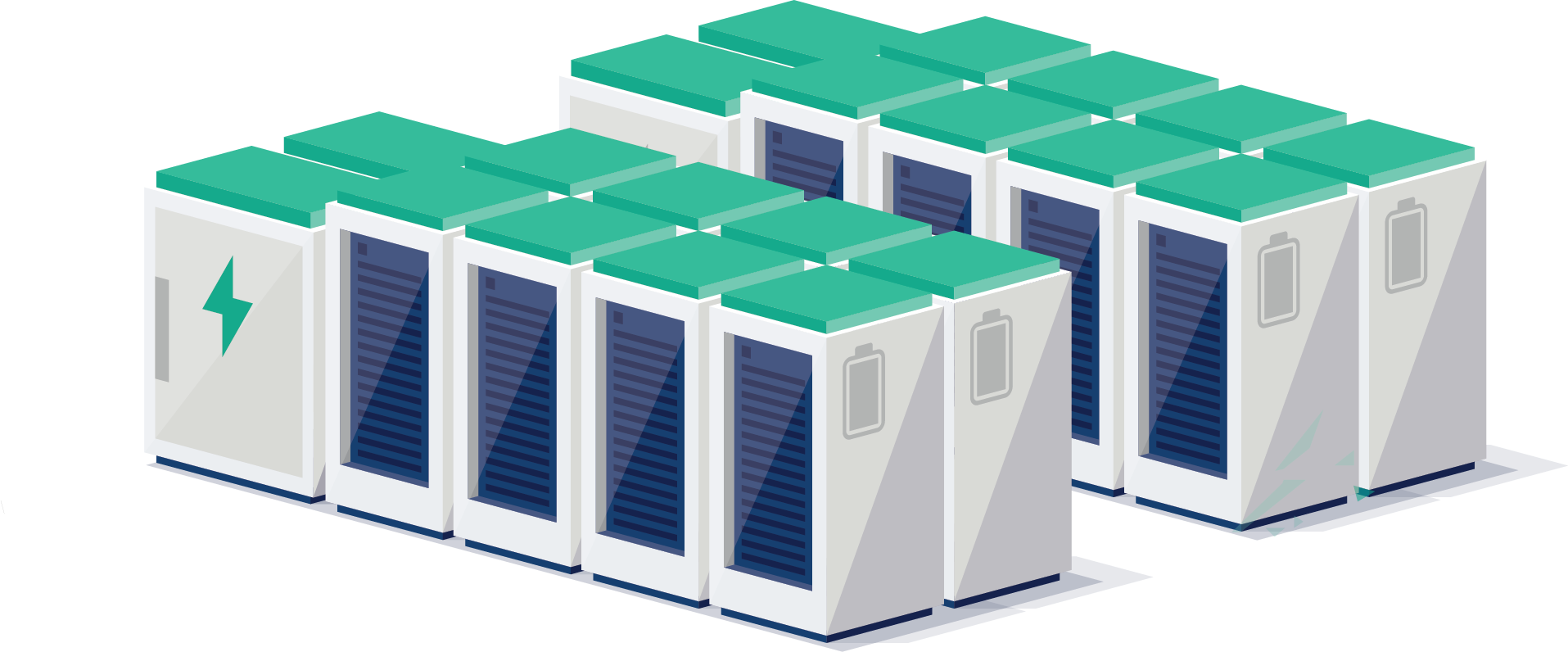
A battery energy storage system (BESS) is a large-scale rechargeable battery installation connected directly to the electric grid. In Sparkfund's DCP model, each BESS unit is roughly the size of one to three 20-foot shipping containers, housed behind a secure protective barrier. Battery energy storage systems charge when energy demand is low and discharge on command from the utility control room during peak periods — improving grid reliability, reducing strain on transmission infrastructure, and putting downward pressure on rates for all customers.
What is Distributed Capacity Procurement (DCP)?
DCP is Sparkfund's model for deploying utility-owned, front-of-the-meter battery energy storage systems at commercial, industrial, and non-profit sites across the distribution grid. Instead of waiting years for new transmission infrastructure, utilities can deploy 1–3 MW BESS units at targeted locations in months, adding accredited capacity exactly where and when the grid needs it most. The result is a faster, cheaper, more flexible path to capacity that benefits utilities, large-load customers, host sites, and ratepayers alike.
Where do distributed energy storage systems sit in the grid, and how is that different from other storage?
At the top, large-scale transmission-tied storage (projects of 50 MW or more) handles bulk capacity. These are standalone battery farms that provide grid-wide services. They're valuable, but they take years to site, permit, and build, and they don't solve distribution-level constraints.
At the bottom, behind-the-meter storage (home batteries, commercial solar-plus-storage, demand response programs) sits on the customer side of the utility meter. These systems reduce consumption from a single building but don't add physical capacity to the distribution system. They can't be accredited as supply-side resources.
DCP fills the gap in between. Front-of-the-meter battery energy storage systems at 1–3 MW are connected directly to the distribution grid — utility-owned, utility-dispatched, and integrated into utility control systems. They add physical supply-side capacity at the exact nodes where the grid is constrained, and they can be deployed in months, not years. That's the distribution layer that bulk transmission storage can't reach and behind-the-meter programs can't provide.
How is DCP different from demand response?
Demand response programs reduce electricity consumption during peak periods. They ask customers to use less. DCP adds supply: physical battery energy storage systems that store energy and release it on command from the utility control room. Unlike demand response, DCP is not dependent on customer behavior or participation rates. It's infrastructure. It performs like a peaker plant: predictably, dispatchably, and on the stack.
What does a battery energy storage system installation look like?
Each BESS unit is roughly the size of one to three 20-foot shipping containers housed behind a secure, protective barrier. A typical installation includes one to three battery energy storage system units plus associated electrical infrastructure. Sparkfund works with each host site to find a placement that fits the property and complies with all local codes, noise ordinances, and aesthetic requirements.
How fast can distributed energy resource deployment happen with DCP?
First capacity is typically available within 6 to 9 months of agreement. At scale with a utility partner, Sparkfund can deploy 100–300 MW per year. That speed comes from our Conforming Project Playbook — templatized utility-grade designs, competitive vendor bidding across civil, mechanical, BESS, and balance-of-system, and open-book cost management that captures falling battery prices in real time. The first DCP builds the template. Every one after deploys faster and cheaper.
Is DCP proven?
Yes, both the technology and the commercial model. Battery energy storage systems are mature, proven infrastructure. The Electric Power Research Institute found that failure rates dropped 98% between 2018 and 2024. And the DCP model itself is now live: Xcel Energy's Capacity*Connect, the first-in-the-nation distributed capacity procurement program, was approved unanimously by the Minnesota PUC on April 2, 2026, and is actively deploying.
How DCP Works: Plan. Deploy. Dispatch.
What is Sparkfund's service model for distributed energy storage deployment?
Every DCP follows the same three-phase framework: from network planning through field deployment to long-term grid dispatch and operations.
Phase 1: Plan Sparkfund starts with network topology planning and site assessment. We evaluate grid characteristics, identify optimal locations for distributed energy resource deployment on specific feeders and distribution nodes, and determine system configuration requirements. From there, we work alongside the utility to conduct targeted host engagement and community outreach in the relevant service territory — identifying, recruiting, and vetting host sites that meet the grid's specific siting requirements. Sparkfund brings both a national network of pre-vetted commercial and industrial sites and the local outreach capability to build a host pipeline from the ground up with each utility partner.
Phase 2: Deploy Sparkfund handles everything between agreement and energization: capacity accreditation, site acquisition, permitting, construction, and vendor management — on time, on budget, to utility-grade standards. More than 80% of program value is competitively bid to a local vendor ecosystem. The Conforming Project Playbook standardizes designs across every cohort so that soft costs and engineering time decrease with each deployment.
Phase 3: Dispatch Once energized, every battery energy storage system is integrated with DERMS, ADMS, and SCADA, and dispatched by the utility to serve grid needs. Sparkfund provides ongoing monitoring and program support. The capacity is accredited on the resource plan. It performs like utility infrastructure because it is utility infrastructure.
Sparkfund's DCP model, each BESS unit is roughly the size of one to three 20-foot shipping containers, housed behind a secure protective barrier. Battery energy storage systems charge when energy demand is low and discharge on command from the utility control room during peak periods — improving grid reliability, reducing strain on transmission infrastructure, and putting downward pressure on rates for all customers.
What is the Sparkfund advantage?
Five specific capabilities, working together. Most deployment services providers can handle one or two of these. Delivering DCP at scale requires all five:
- Grid analytics and siting: Identifying where capacity is needed and matching sites to grid constraints before a program begins.
- Capacity accreditation: Navigating ISO/RTO accreditation processes so the assets count on the stack from day one.
- Site acquisition and host engagement: Working with each utility partner to identify the right locations on the distribution system, then conducting local host recruitment and community outreach in the service territory. Sparkfund also brings a national network of pre-vetted sites and the on-the-ground capability to build a host pipeline that fits the specific feeder and grid needs of each program.
- Construction and vendor management: Competitive procurement, templatized designs, open-book cost management, and utility-grade execution.
- Long-term operations integration: DERMS/SCADA integration and program management over the full asset lifecycle.
The result: ~25% lower all-in cost than traditional third-party approaches, and a delivery record of 3,200+ completed energy projects across 43 states with 1% variance to time and budget.
DCP for Data Centers & Large Loads
How can a data center use DCP to access grid capacity faster?
In constrained markets, large load connections are delayed by years as transmission upgrades work through planning queues. DCP offers an alternative: the large-load customer funds the deployment of front-of-the-meter battery energy storage systems in the utility's territory through a structured commercial agreement — an Energy Services Agreement, bilateral contract, or large-load tariff. Sparkfund deploys the assets. The utility owns and operates them. The large-load customer receives matched accredited capacity credits when the assets achieve ISO/RTO accreditation.
This structure lets data centers access accredited grid capacity in months, not years, in any geography where they need it.
What does the large-load customer actually commit to?
The large-load customer commits capital toward DCP deployment through a formal commercial agreement. The specific structure depends on the regulatory market, financing preferences, and long-term capacity strategy. Sparkfund helps navigate the options. The commitment is a structured capacity purchase. Google demonstrated this when they committed $50 million toward Xcel Energy's Capacity*Connect program, five weeks before the Minnesota PUC approved it.
Who owns the battery energy storage systems?
The utility. DCP assets are utility-owned, utility-dispatched infrastructure — not behind-the-meter assets, not third-party-owned equipment. That's what allows them to be accredited on the resource plan and integrated into the utility's control systems. The large-load customer funds deployment and receives matched capacity credits; they do not own or operate the hardware.
Does the battery provide backup power to the data center?
No. Battery energy storage systems deployed through DCP are connected "in front of the meter," meaning they serve the grid as a whole — not any individual property. The energy they store and dispatch benefits all customers on the system. Host sites and large-load customers will not experience direct backup power as a result of hosting or funding a system.
What happens to community ratepayers when a large load funds DCP?
Co-benefits accrue to all ratepayers. Improved grid utilization puts downward pressure on rates across the system. The data center enters the community as a source of local investment — not just load. Host sites earn monthly lease payments. Local vendors earn construction and maintenance contracts. The Brattle Group's independent analysis found that a 10% improvement in system utilization reduces rates for all customers by 3.4% while utility earnings grow.
For Utilities & DER Programs
What does distributed capacity procurement mean for utilities?
DCP gives utilities a new tool for their planning portfolio: front-of-the-meter battery energy storage systems that are utility-owned, accredited on the resource plan, and deployed through the IRP process. It adds physical supply-side capacity at the distribution level — exactly where load growth is concentrated — at approximately 25% lower cost than traditional third-party approaches. For commissioners and regulators, DCP is a program that improves grid utilization and puts downward pressure on rates while utility earnings grow.
How does DCP fit into utility DER programs?
DCP is one of the most effective utility DER programs for adding accredited, dispatchable capacity to the distribution grid. Unlike virtual power plant programs or demand response aggregations — which depend on customer participation and can't be accredited as supply-side resources — DCP battery energy storage systems are utility-owned infrastructure that counts on the resource plan from day one. They integrate with DERMS, ADMS, and SCADA, and are dispatched directly from the utility control room. For utilities building out their DER program portfolio, DCP fills the distribution layer that transmission-tied storage can't reach.
How does DCP complement large-scale transmission-tied storage?
Transmission-tied storage handles bulk capacity at the transmission level. DCP unlocks the distribution layer with targeted 1–3 MW battery energy storage systems at commercial and industrial sites, deployed exactly where distribution constraints are emerging. The two work together to complete a utility's energy storage portfolio.
What does ~25% lower cost mean?
Sparkfund's model eliminates fee stacking, allocates risk efficiently through data-backed Base Scope pricing, returns unused contingency to the customer, uses templatized project designs, competitively bids 80% of program value to local vendors, and leverages the utility's balance sheet to optimize working capital. The result is an all-in delivered cost approximately 25% lower than traditional third-party approaches, benchmarked at ~$2,092/kW versus $2,780–$3,500/kW for traditional third-party models.
What does "downward pressure on rates" mean?
DCP adds capacity exactly where the grid has room for it, improving system utilization. Independent Brattle Group analysis for the Utilize Coalition found that a 10% improvement in US system utilization reduces rates for all customers by 3.4%, while utility earnings grow. Better grid utilization is not a trade-off. It is how utilities serve load growth and reduce rates at the same time. Sparkfund is a founding member of the Utilize Coalition that commissioned this research.
Can DCP help with commissioner confidence?
Yes. More than 80% of every dollar is competitively bid to a local vendor ecosystem. Deployment runs through the IRP. A program that adds grid headroom and puts downward pressure on rates is exactly what utilities bring to their commissioners with confidence. The Capacity*Connect program earned a unanimous vote from the Minnesota PUC on April 2, 2026, with independent third-party evaluation requirements, Environmental Justice siting criteria, and small and diverse business contracting provisions built in from the start.
Hosting a Battery Energy Storage System
What does it mean to host a battery energy storage system?
Host organizations are non-residential properties (businesses, houses of worship, nonprofits, schools, industrial and commercial facilities) that provide space on their property for a battery energy storage system that the utility owns, operates, and maintains. Hosts receive monthly lease payments for the duration of the agreement.
How are battery energy storage system hosts compensated?
Host compensation varies by program, utility partner, region, and site-specific factors including the size and configuration of the system. Specific payment terms are defined in a site hosting agreement. Typical contracts provide monthly payments for 15–20 years.
What are the host's responsibilities?
Minimal. Once the battery energy storage system is installed, it does not require day-to-day involvement from the host. Sparkfund handles installation; the utility manages ongoing operations and maintenance. Hosts provide the space, comply with the site hosting agreement, and receive monthly payments. All site access is coordinated in advance.
How are host sites selected?
Sites are identified through engineering and grid analysis, prioritizing locations where the distribution system would benefit most. Sparkfund intentionally targets a wide range of property types, including sites in environmental justice communities, ensuring that hosting opportunities and their financial benefits are broadly distributed. There is no general application or open enrollment; host engagement is initiated on a project-specific basis.
What happens at the end of the contract?
At the end of the term, Sparkfund and the utility work with the host to either renew and upgrade the system or fully decommission it, removing all equipment and restoring the property to its original condition.
Safety
Are battery energy storage systems safe?
Yes. Battery energy storage system technology has improved dramatically. The Electric Power Research Institute found that failure rates dropped 98% between 2018 and 2024. Every Sparkfund deployment is professionally designed, installed, and maintained to meet rigorous national safety standards.
What safety standards apply to battery energy storage systems?
All systems are built and operated in compliance with Underwriters Laboratories 9540 and 9540A (UL 9540/9540A) for system integration and fire safety testing, National Fire Protection Association 855 (NFPA 855), the National Electric Code, OSHA safety protocols, and all applicable local codes and noise ordinances.
How are battery energy storage systems monitored?
Every battery energy storage system is monitored around the clock from the utility's control center. Certified technicians conduct annual on-site inspections, with additional inspections after severe weather events. Automated alerts notify the response team immediately if anything unusual is detected.
What happens in an emergency?
Sparkfund develops a site-specific emergency response plan for every installation in coordination with local first responders. Each system is equipped to automatically alert emergency services if needed. Local responders receive training specific to battery energy storage systems before installation begins.
How much noise do the batteries make?
The cooling systems generate some sound during operation, similar in level to a commercial HVAC unit. All systems are designed to comply with local noise ordinances. Sparkfund completes noise modeling before installation and incorporates mitigation measures such as sound-attenuating enclosures and barrier zones as needed.
Community & Ratepayer Benefits
Who benefits from distributed energy storage beyond the host site?
Everyone on the distribution system. Distributed energy storage deployed through DCP improves overall grid utilization, which puts downward pressure on rates for all customers. Host sites earn lease payments. Local vendors earn construction and maintenance work. And because DCP battery energy storage systems are front-of-the-meter assets, their capacity benefits accrue to the whole system — not just the property where they're sited.
Does DCP prioritize environmental justice communities?
Yes. Sparkfund intentionally sites battery energy storage systems where the grid benefits most, which often includes underserved communities. Environmental Justice siting requirements are built into Xcel Energy's Capacity*Connect program by order of the Minnesota PUC. EJ communities have a real opportunity to host innovative energy infrastructure, earn direct payments, and participate in the benefits of a more reliable, modern grid.
Does DCP support local jobs?
Yes. More than 80% of program value is competitively bid to a local vendor ecosystem — electricians, technicians, civil contractors, and maintenance crews. By deploying at the distribution level, DCP puts work in the communities where the systems are installed, supporting local businesses and tradespeople across every program.
How is DCP different from solar or wind generation?
Solar and wind generate electricity. Battery energy storage systems store and dispatch it. BESS units complement renewable generation by absorbing excess power when supply exceeds demand and releasing it when demand spikes. DCP batteries are particularly valuable for grid reliability because they can respond instantly, be dispatched precisely, and are counted as supply-side capacity on the resource plan — not just flexibility.
Working with Sparkfund
How do I get started with a distributed capacity procurement program?
Talk to our team. Whether you're a utility evaluating DCP as a portfolio addition, a data center or large-load customer looking to accelerate your capacity position, we start with a conversation about your geography, timeline, and goals.
What geographies does Sparkfund operate in?
Sparkfund has deployed projects in 43 states and can operate wherever capacity is needed. We have no geographic constraint. Our host network includes thousands of pre-vetted commercial and industrial sites nationwide, mapped to where the grid is constrained and where load growth is concentrated.
Has Sparkfund done this before?
Yes. Sparkfund has completed 3,200+ energy projects across 43 states at 1% variance to time and budget. The DCP model is now a live, approved commercial program: Xcel Energy's Capacity*Connect was authorized at 200 MW with a $430M three-year program budget following a unanimous PUC vote on April 2, 2026.
What is the Conforming Project Playbook?
It's Sparkfund's operational advantage for battery energy storage system deployment. The Playbook is a set of templatized, utility-grade designs that improve with every deployment. Paired with competitive vendor bidding and open-book cost management, soft costs and engineering time decrease with each program cycle. The first DCP builds the template. Every one after it deploys faster, at lower cost, with higher confidence.